
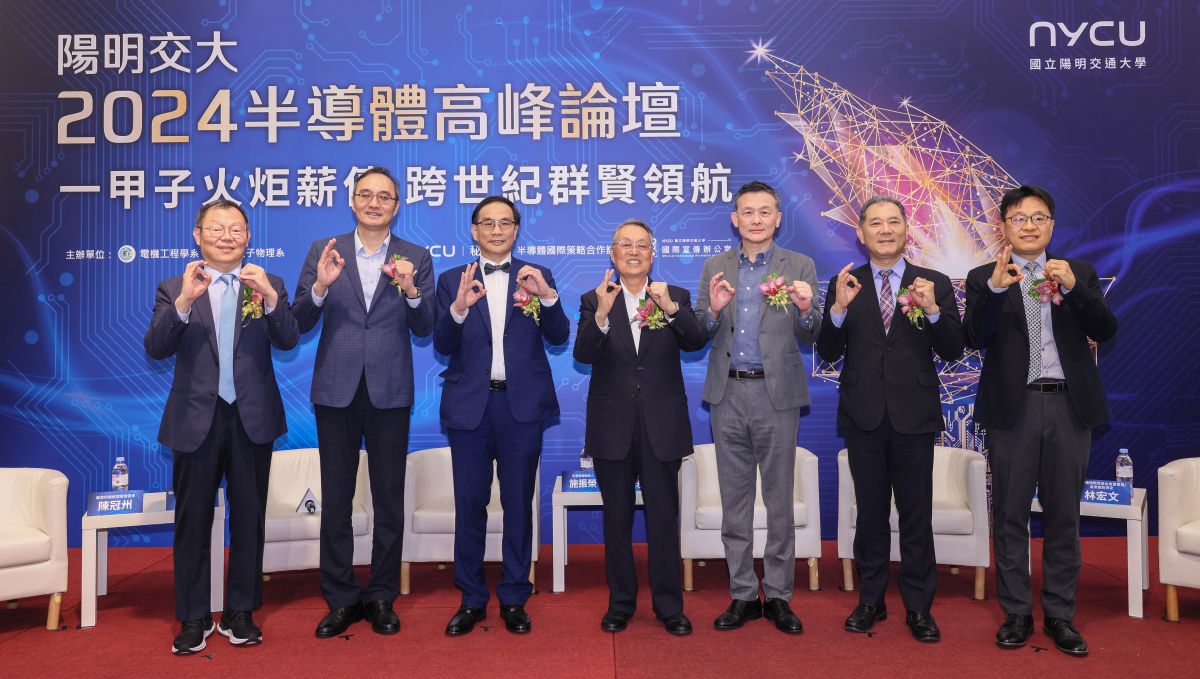
今年適逢電機工程學系、電子物理系創立60年,本校特舉辦「2024半導體高峰論壇」以及「60週年特展」。論壇及展覽活動除了展現陽明交大眾多傑出校友在半導體領域的卓越成就,也藉此機會展望本校在半導體人才培育和產學共創上的未來願景。4月10日的「2024半導體高峰論壇」,我們號召並攜手五位在半導體科技界的重量級校友,聚焦探討台灣半導體產業的「持續競爭之關鍵」和「人才培育與留才策略」等重要議題。
校長林奇宏表示,台灣第一片電晶體就是在陽明交大誕生,現在半導體產業面臨嚴重的人才短缺問題,更顯得學校人才培育的重要性,此次論壇希望藉由這些優秀校友的遠見,探討產業趨勢與困境,讓台灣半導體產業能繼續往前邁進。
台灣在全球半導體產業中的優勢
當談到台灣過去半導體成功的關鍵要素,五位與談人不約而同的談到台灣特有的生態鏈及文化。宏碁集團創辦人施振榮表示,半導體產業從早期的垂直整合走向垂直分工,這樣的模式造就台灣半導體產業的榮景。他指出,矽谷過去是全球半導體生產製造的中心,後來轉到日本,現在轉移到台灣;今天的矽谷,仍然是全球各種新科技最重要的發動機,原因就是維持充沛設計能量。台灣應該以半導體優勢做為制高點,才能創造更大附加價值。
台積電資深副總經理暨副共同營運長侯永清表示,台灣半導體產業的優勢,在於從IC設計、製造、封測、材料與工具、零件等,串連出全球最有效率與進步的生態鏈,這些是經歷數十年全球化,結合不同國家的廠商共同營造的完整生態系,如果有其他國家要籌建與台灣相近的半導體生態鏈,這並不容易。鴻海半導體事業群總經理陳偉銘則指出,台灣半導體業制霸全球的關鍵,在於集合美國的創新、日本的紀律,以及中華文化的勤勞,對於半導體業而言,這三個特質缺一不可。
解決人才短缺困境:半導體教育向下扎根、高階人才培育、外國人才引進
討論到半導體人才短缺的難題,可從擴大半導體人才庫,包括半導體教育(科技教育)的向下紮根、高階人才(博士班)的培育,以及從國外人才的引進幾個面向做起。新思科技全球副總裁李明哲說明,去年已和本校聯手共同針對高中生推動「半導體與晶片設計科普夏令營」,也很樂意將辦理營隊的知識與成果分享給其他有意願將半導體教育向下紮根的單位。
此外,台積電也與本校長期合作開設「大哥哥大姊姊講半導體」課程,透過同齡及有趣的課程,提高高中生的學習興趣。本次論壇也特別邀請竹北高中學子,提供和年輕的世代分享的平台,幫助國家未來主人翁及早瞭解半導體教育及產業議題。除了提升人才庫的「量」。博士班高階人才的培養,以及國外人才的引進,也是保證人才庫「品質」的策略。陳偉銘表示,對於無論是在台灣的外籍工作者,抑或是海外分公司對待當地員工,對於其文化的尊重,是能夠留才的重要因素。
聯發科技總經理暨營運長陳冠州也以「O、A、G、I」:開放(Open)、有企圖心(Ambitious)、國際化(Global)、創新(Innovation)四個標語,與大家分享國際公司選才所重視的特質。
未來台灣半導體產業應著重「培養人才」和「技術研發」
現在人工智慧(AI)蓬勃發展,而半導體是AI的基本載具。侯永清表示,展望未來十年,幾乎找不到任何一項材料可以取代半導體,台灣半導體產業要維持競爭優勢,唯有持續研發,技術領先才能確保競爭優勢、繼續生存的關鍵,而技術研發靠的是人才,未來的課題應是「持續研發」和「培育人才」雙軌並進。
Celebrating NYCU’s 60 Years of Semiconductor Education: Senior Leaders of Taiwan’s Semiconductor Industry Convene to Explore Future Development Path
This year marks the 60th anniversary of establishing the Department of Electronics and Electrical Engineering (DEE) and the Department of Electrophysics at National Yang Ming Chiao Tung University (NYCU). We are organizing the 2024 Semiconductor Summit Forum and a 60th Anniversary Special Exhibition to commemorate this milestone. In addition to showcasing the outstanding achievements of numerous distinguished alumni in the field of semiconductors, these forum and exhibition activities also provide an opportunity to envision the university’s future vision in semiconductor talent cultivation and industry-academic collaboration.
The 2024 Semiconductor Summit Forum on April 10th convened and collaborated with five senior alumni in the semiconductor technology sector, focusing on discussing crucial issues such as the “key to sustainable competitiveness” and “strategies for talent cultivation and retention” in Taiwan’s semiconductor industry.
President Chi-Hung Lin stated that the first transistor in Taiwan was born at NYCU. With the semiconductor industry facing a severe talent shortage, the importance of talent cultivation in universities becomes even more apparent. The forum aims to leverage the foresight of these outstanding alumni to discuss industry trends and challenges, allowing Taiwan’s semiconductor industry to continue advancing.
The Advantages of Taiwan in the Global Semiconductor Industry
When discussing the key factors behind Taiwan’s past success in the semiconductor industry, all five panelists unanimously pointed to Taiwan’s unique ecosystem and culture. Mr. Stan Shih remarked that the semiconductor industry has transitioned from vertical integration in its early days to vertical specialization, which has contributed to Taiwan’s semiconductor industry prosperity. He noted that Silicon Valley was once the global center for semiconductor production, then shifted to Japan, and now to Taiwan. Silicon Valley today remains a crucial engine for various new technologies globally, primarily due to its abundant design energy. Mr. Shih emphasized that Taiwan should leverage its semiconductor advantages as a vantage point to create even greater added value.
Mr. Cliff Hou emphasized that the advantage of Taiwan’s semiconductor industry lies in the interconnected ecosystem spanning IC design, manufacturing, testing, materials and tools, components, and more, creating the world’s most efficient and progressive supply chain. These components have been developed over decades of globalization, bringing together manufacturers from different countries to build a comprehensive ecosystem. He noted that replicating a semiconductor ecosystem similar to Taiwan’s in other countries would be challenging.
Mr. Bob Chen pointed out that the key to Taiwan’s semiconductor industry dominating globally lies in the combination of American innovation, Japanese discipline, and the diligence of Chinese culture. He emphasized that these three characteristics are indispensable for the semiconductor industry.
Addressing Talent Shortage Dilemma: Rooting Semiconductor Education, Cultivating High-Level Talent, and Introducing Foreign Talent
When discussing the challenge of semiconductor talent shortage, solutions may begin with expanding the semiconductor talent pool, including rooting semiconductor education (science and technology education) downward, cultivating high-level talent (Ph.D. programs), and introducing talent from abroad. Mr. Robert Li explained that, in collaboration with our university last year, he spearheaded the “Semiconductor and Chip Design Science Summer Camp” aimed at high school students. He also expressed willingness to share the knowledge and outcomes of the camp with other organizations interested in rooting semiconductor education downward.
Additionally, TSMC has long collaborated with our university to offer the “Big Brothers and Big Sisters Talk About Semiconductors” program. The program aims to enhance high school students’ interest in learning through peer-led and engaging courses. The forum also extended a special invitation to students from National Chupei Senior High School (CPSH), providing a platform for sharing with the younger generation, thereby assisting future leaders of the country in gaining early insights into semiconductor education and industry issues.
In addition to enhancing the “quantity” of the talent pool, cultivating high-level talent through doctoral programs and introducing foreign talent are also strategies to ensure the “quality” of the talent pool. Mr. Bob Chen stated that foreign workers in Taiwan or overseas subsidiaries treat local employees and respect their culture, which is crucial in retaining talent. Mr. Joe Chen also emphasized the importance of “OAGI,” which refers to openness (O), ambition (A), globalization (G), and innovation (I) as essential qualities international companies value when selecting talent.
Future Focus for Taiwan’s Semiconductor Industry: Talent Cultivation and Technological Research and Development
With the rapid development of Artificial Intelligence (AI), semiconductors serve as its fundamental carrier. Mr. Cliff Ho stated that looking ahead to the next decade, hardly any material can replace semiconductors. Taiwan’s semiconductor industry must continue to innovate technologically to maintain its competitive advantage. This technological leadership is crucial for sustaining competitiveness and survival. As technological research and development rely on talent, the future focus should be on the dual tracks of “continuous R&D” and “talent cultivation.”